
Muslim History from Early Days to Modern Achievements (Origins, Culture, and Influence)
Muslim history begins in the 7th century with the Prophet Muhammad's mission in Mecca and Medina, setting a foundation that shaped religious, cultural, scientific, and political life across continents. From those early days, Islamic empires quickly expanded across vast territories, influencing trade, learning, and governance. This history stretches from the original spread of Islam and the flourishing of its Golden Age to key modern achievements in science, culture, and global politics.
Understanding these developments highlights how Muslim societies contributed major advances in fields such as mathematics, medicine, and architecture. Their legacy continues to resonate today, as Muslim-majority countries navigate both challenges and opportunities in the modern world. This post covers the broad scope of Muslim history, from its early origins through to its lasting impact on today’s global stage.
For a broad visual overview of these centuries of history, this video is a valuable resource: The Islamic World: 1000 Years in 18 Minutes.
Origins and Early Expansion of Islam
The story of Islam begins in the 7th century Arabian Peninsula, a time and place marked by tribal conflict and deeply rooted pagan traditions. Out of this environment emerged a revolutionary faith through the Prophet Muhammad, whose revelations reshaped history and society in profound ways. From the first divine messages to the rapid unification and expansion of the Muslim community, these beginnings set the stage for Islamic civilization's enduring impact.
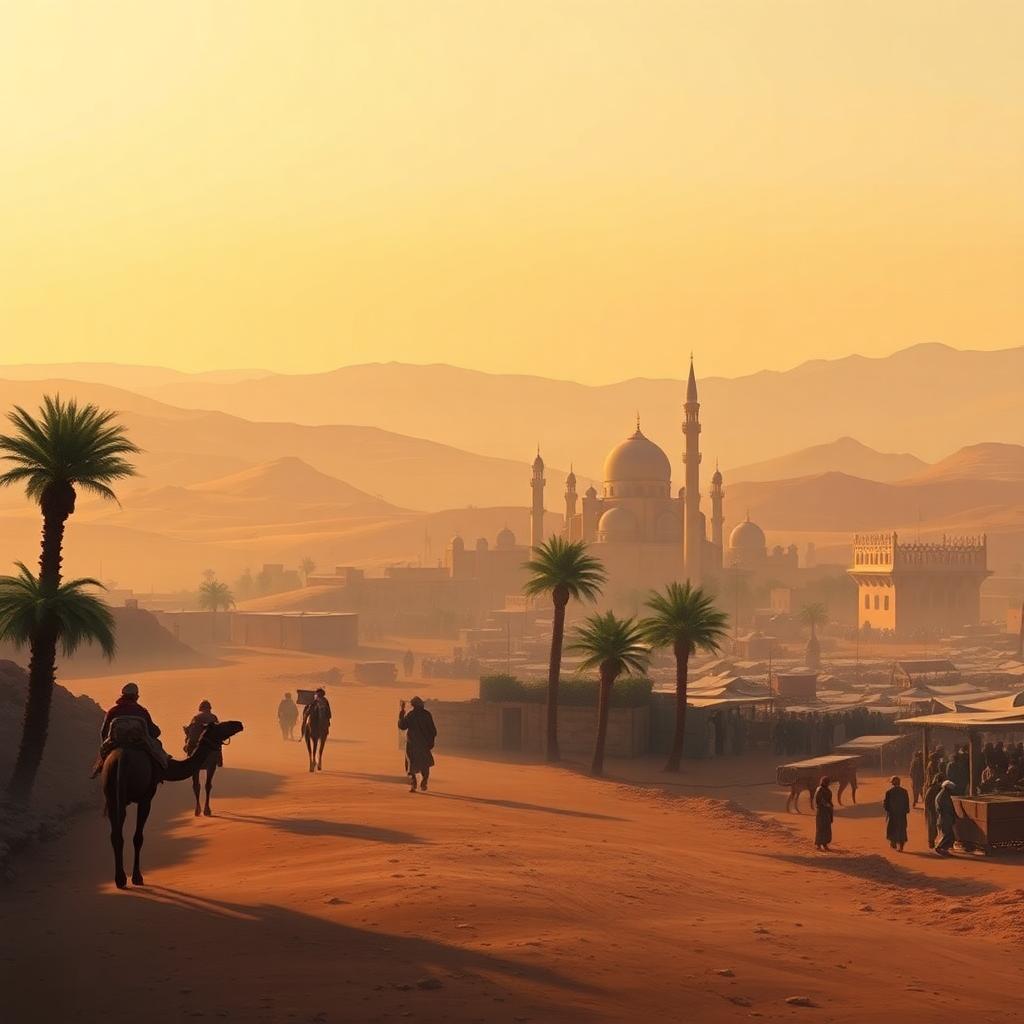
Image created with AI representing early Islamic cityscape
The Prophet Muhammad and First Revelations
Islam centers around the Prophet Muhammad, born in Mecca around 570 CE. At the age of 40, Muhammad received his first revelation from the angel Gabriel, calling him to convey the message of one God (Allah) and to guide humanity away from polytheism and moral corruption. These revelations, occurring over 23 years, were later compiled into the Qur'an, the sacred text of Islam.
Muhammad’s message emphasized equality, justice, and compassion. It was met with resistance by Mecca’s ruling elites, whose economic and social status depended on established pagan practices. But his followers grew steadily, drawn by the call to worship a single, just God and to live by strong ethical principles.
The Hijra and the Foundation of the Muslim Community
Faced with persecution, Muhammad and his followers migrated to Yathrib (later Medina) in 622 CE—a journey known as the Hijra. This migration marks the beginning of the Islamic calendar and is a defining moment in Muslim history. In Medina, Muhammad established the first Islamic political entity and community, known as the Ummah.
The Constitution of Medina, an early social contract, united the diverse tribes and religious groups of the city under a common framework emphasizing cooperation, justice, and religious freedom. This move transformed Islam from a solely religious movement into a socio-political force, affirming community values and governance based on belief and law.
Establishing the Five Pillars of Islam
During these early days, Muhammad outlined essential religious practices that would unite believers worldwide—today known as the Five Pillars of Islam. These are:
- Shahada: The declaration of faith, acknowledging there is no god but Allah, and Muhammad is His prophet.
- Salah: Ritual prayer performed five times daily.
- Zakat: Giving charity to the poor and needy, promoting social justice.
- Sawm: Fasting during the month of Ramadan, fostering self-discipline and empathy.
- Hajj: Pilgrimage to Mecca, an obligation once in a lifetime for those able.
These pillars defined Muslim identity and practice, forging spiritual unity even as the community expanded.
The Rashidun Caliphate and Rapid Expansion
After Muhammad’s passing in 632 CE, leadership passed to his close companions, known as the Rashidun Caliphs: Abu Bakr, Umar, Uthman, and Ali. This period, lasting just under 30 years, was essential for organizing the young Muslim empire, enforcing Islamic law, and expanding territorially.
Under the Rashidun Caliphate, Islam spread quickly beyond Arabia, reaching parts of the Byzantine and Sasanian empires. Armies, motivated and unified by their faith, captured key regions like Syria, Iraq, Egypt, and Persia. This expansion was not only military but also cultural, as Islam’s social and political systems took root and reshaped vast populations.
The Caliphs focused on:
- Consolidating religious unity by standardizing the Qur'an.
- Establishing Islamic governance based on the Prophet’s teachings.
- Balancing tribal loyalties and broader Muslim identity, which set the stage for later sectarian tensions.
Early Sectarian Divisions
This period also sowed the seeds of the major sectarian split within Islam. Disagreements over rightful succession led to the development of the Sunni and Shia branches, with the latter supporting Ali and his descendants as legitimate leaders. Another early group, the Kharijites, broke away over political and theological disputes, emphasizing strict interpretations of piety and justice.
These divisions were rooted in struggles over leadership and governance but profoundly influenced Islamic theology and politics for centuries to come.
This early chapter in Muslim history illustrates how Islam quickly moved beyond a faith community to an organized society with defined religious practices, governance, and dynamic growth. The foundations laid during Muhammad’s life and the Rashidun Caliphate formed the blueprint that shaped the centuries that followed.
For more detailed insights into these pivotal events, you can explore the biography of Prophet Muhammad or dive deeper into the history of the Rashidun Caliphate. The establishment of the pillars that guide Muslim life is well explained in this overview of the Five Pillars of Islam.
The Golden Age of Islam: Intellectual and Cultural Flourishing
The Golden Age of Islam, stretching roughly from the 8th to the 14th century, marked a period where Muslim scholars, artists, and leaders transformed knowledge and creativity across many fields. This era saw the rise of centers like the House of Wisdom in Baghdad, where ideas from different civilizations blended and evolved. These centuries weren’t just about preserving ancient wisdom; Muslim thinkers pushed boundaries, creating foundations still influencing science, medicine, art, and governance today.
Scientific and Medical Achievements
During this flourishing period, Muslim scholars made significant breakthroughs in several sciences:
- Algebra: The mathematician Al-Khwarizmi developed systematic methods of solving equations, giving birth to algebra as we know it. His work was so essential that the word “algorithm” traces back to his name.
- Astronomy: Scholars charted stars, improved astrolabes, and refined calendars. They corrected earlier Greek models and laid groundwork that guided navigators and scientists for centuries.
- Medical Encyclopedias: Figures like Ibn Sina (Avicenna) compiled comprehensive medical texts, such as the Canon of Medicine. This book combined Greek and Persian knowledge with their own discoveries and served as a medical reference in Europe for hundreds of years.
- Hospitals and Hygiene: The establishment of well-organized hospitals with wards, pharmacies, and patient records was a Muslim innovation. Emphasis on hygiene and public health, including washing and quarantine practices, improved community well-being.
- Chemistry and Optics: Al-Razi contributed to chemistry with methods that resemble modern scientific experimentation. Ibn al-Haytham revolutionized optics by explaining vision through light reflection and refraction, paving the way for modern optics.
These accomplishments weren’t isolated; instead, they formed a vast, interconnected ecosystem of learning supported by rulers who funded scholars and libraries. The translation movement was key here: texts from Greek, Persian, and Indian sources were translated into Arabic, enabling scholars to critique, expand, and transmit knowledge globally.
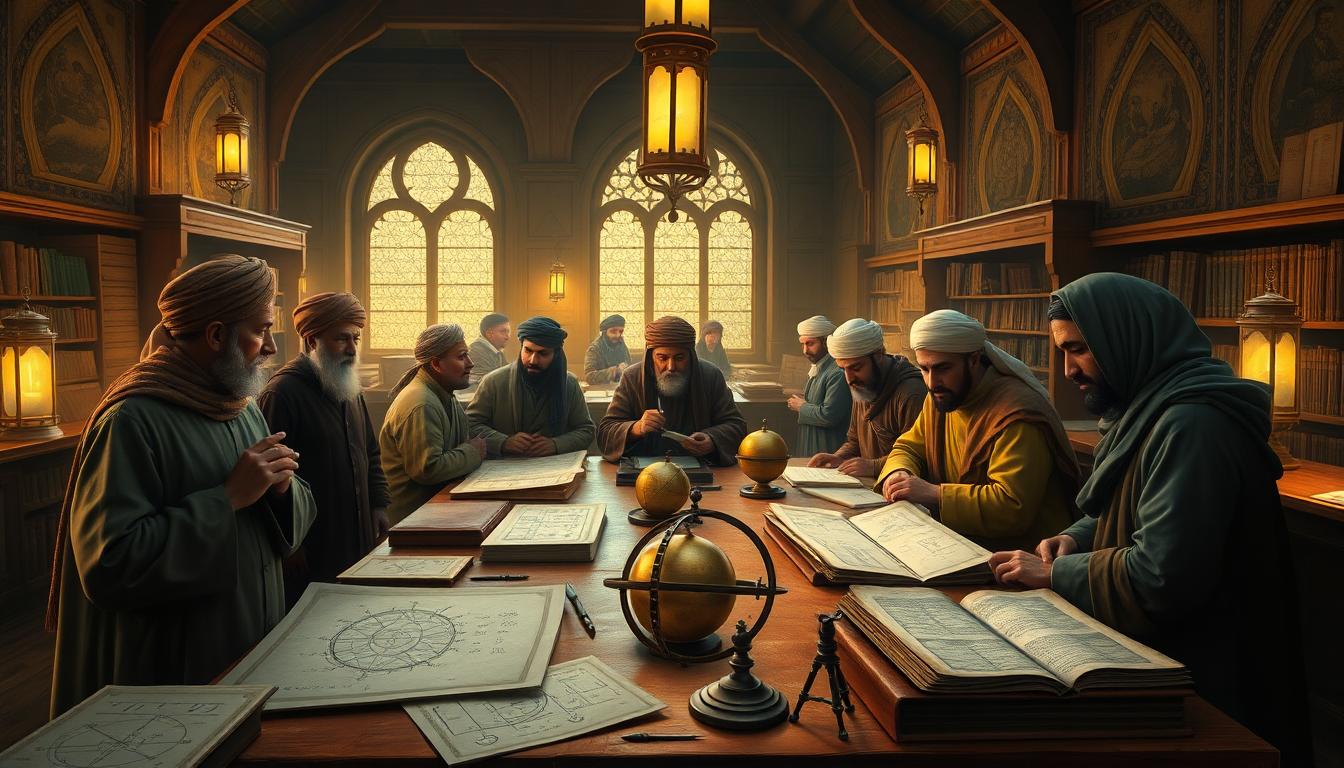
Abbasid-era scholars studying algebra, astronomy, and medicine in the House of Wisdom — Image created with AI
For a detailed overview of this scientific flourishing, the Golden Age of Islamic science offers extensive insights into how these achievements changed the world.
Art, Architecture, and Governance
The Golden Age wasn’t just about science; it reshaped culture and governance in ways that influenced societies far beyond the Muslim world.
- Islamic Art and Calligraphy: Instead of figurative images, Islamic art flourished through elaborate calligraphy and geometric patterns. Calligraphy wasn’t just decoration—it symbolized divine beauty and was used to preserve sacred texts elegantly. Geometric patterns, reflecting infinite symmetry, suggested order and unity.
- Architectural Marvels: The Dome of the Rock in Jerusalem stands as one of the oldest and most iconic Islamic monuments. Built in the late 7th century, its golden dome and intricate mosaics represent a synthesis of spiritual symbolism and architectural brilliance. This shrine influenced mosque design for centuries.
- Governance and Justice: Islamic rulers developed legal frameworks known as fiqh, which interpreted Islamic law for daily life. Alongside this, they introduced welfare systems such as the Bayt al-Mal (public treasury) to support the poor, orphans, and travelers. These welfare institutions were among the first to integrate social responsibility directly into governance.
This blend of artistic excellence and practical governance formed a society where culture, spirituality, and justice were intertwined—offering a model still studied and admired today.
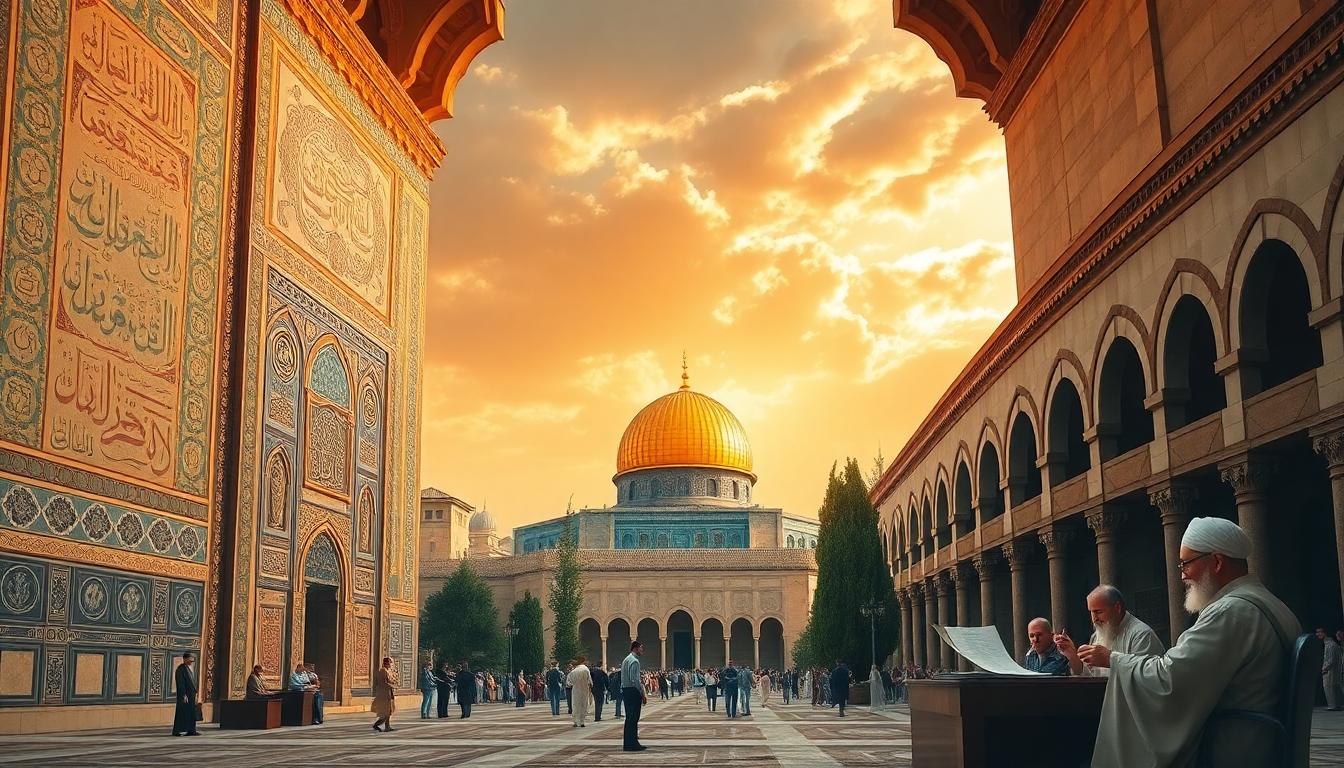
The Dome of the Rock, calligraphy and geometric patterns reflect the era’s cultural and governance achievements — Image created with AI
For a deeper dive into the Dome of the Rock’s history and architecture, the Encyclopedia Britannica’s article on the Dome of the Rock offers a comprehensive summary. Meanwhile, those interested in the symbolic power of geometric patterns in Islamic art can explore this insightful essay on geometric patterns in Islamic art.
These facets of the Golden Age show how Muslim civilization built a vibrant, enduring legacy—melding intellectual breakthroughs with rich cultural and political structures.
Early Modern Islamic Empires and Global Influence
The rise of the Ottoman, Safavid, and Mughal Empires in the early modern period marks one of Islam’s most dynamic chapters. These three powerful states shaped not only the political and cultural contours of their regions but also influenced global trade, religion, and diplomacy. Their growth combined military innovation with rich cultural achievements, all while controlling crucial trade routes, especially across the Indian Ocean. This section walks through their political systems, military advances, cultural legacies, and how they helped define a worldwide Islamic identity.
Ottoman Empire: The Expansive Sunni Powerhouse
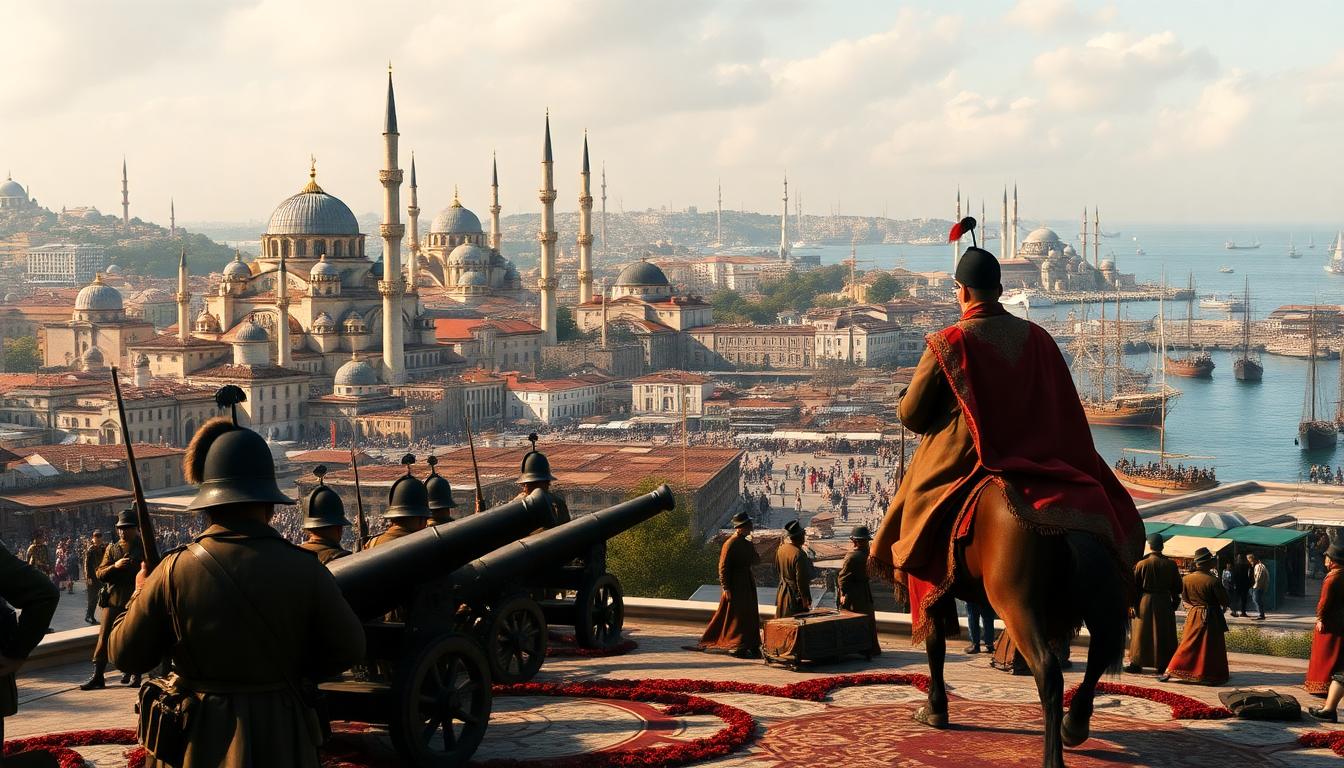
The Ottoman Empire lasted for over six centuries and at its height controlled vast territories spanning Southeastern Europe, the Middle East, and North Africa. It stood out for its well-organized political structure: a sultan as the absolute ruler backed by a complex bureaucracy and a legal system blending Islamic law with local customs.
Military innovations helped the Ottomans become a major power. They were early adopters of gunpowder technology, fielding powerful cannons and the elite Janissary infantry, trained through the devşirme system of recruiting Christian boys. Their navy controlled key parts of the Mediterranean.
Trade wise, the Ottomans dominated critical land and sea routes linking Europe with Asia and Africa. Cities like Constantinople (Istanbul) became hubs of commerce, culture, and religious authority, with the empire asserting itself as protector of Islam’s holy sites in Mecca and Medina.
Safavid Empire: Shi’ism and Persian Culture
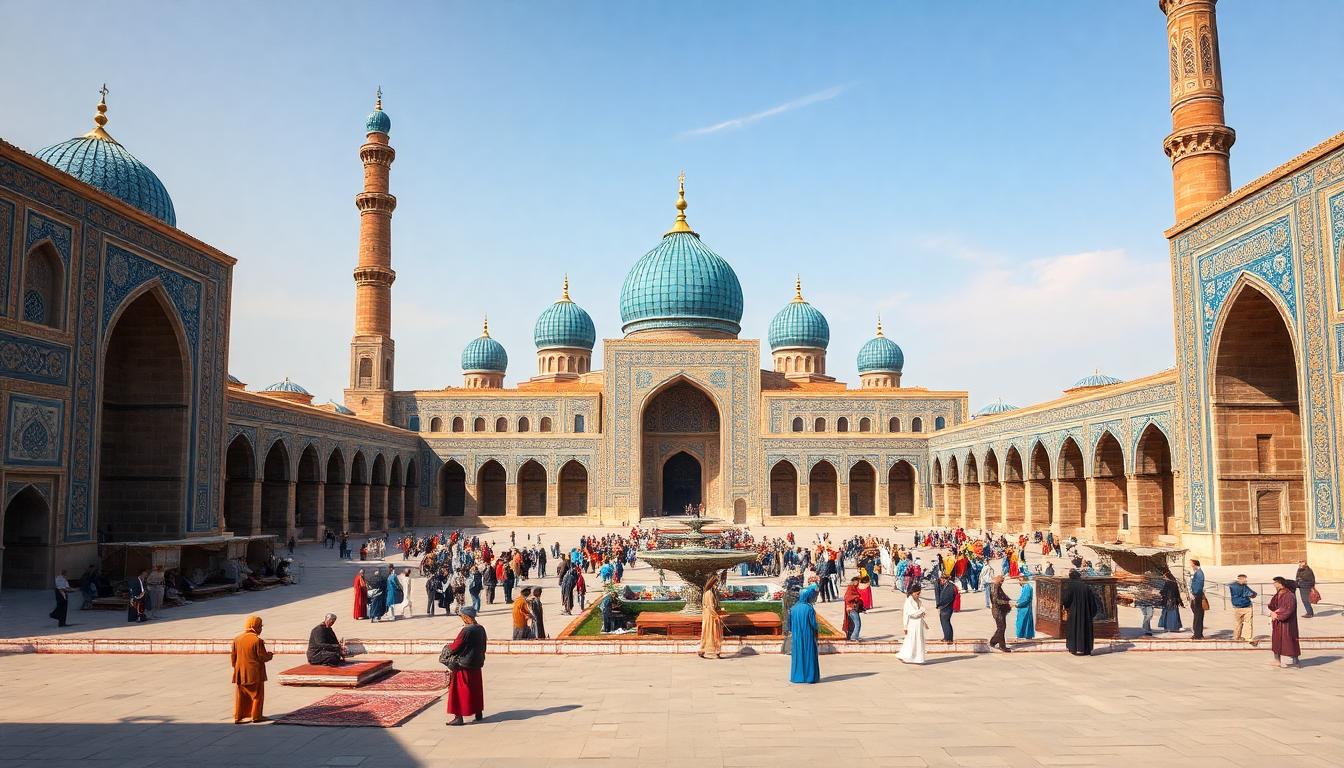
Centering on modern-day Iran, the Safavid Empire established Twelver Shi’ism as the official state religion, setting it apart from the Sunni Ottomans and Mughals. Founded by Shah Ismail I, the Safavids worked hard to build a strong centralized government, reducing tribal rivalries with a loyal standing army, including household troops and slave soldiers.
Culturally, the Safavid period is famous for stunning architecture, carpet weaving, and a flourishing of Persian art and poetry. Economically, their silk trade was vital, especially as they connected with European traders, particularly the East India Companies. This made the Safavid realm a crucial node in Eurasian trade networks.
Politically, the Safavid system relied on land grants that supported military officials, combining Persian traditions with Islamic governance to create a resilient administration.
Mughal Empire: Indo-Islamic Synthesis and Vast Wealth
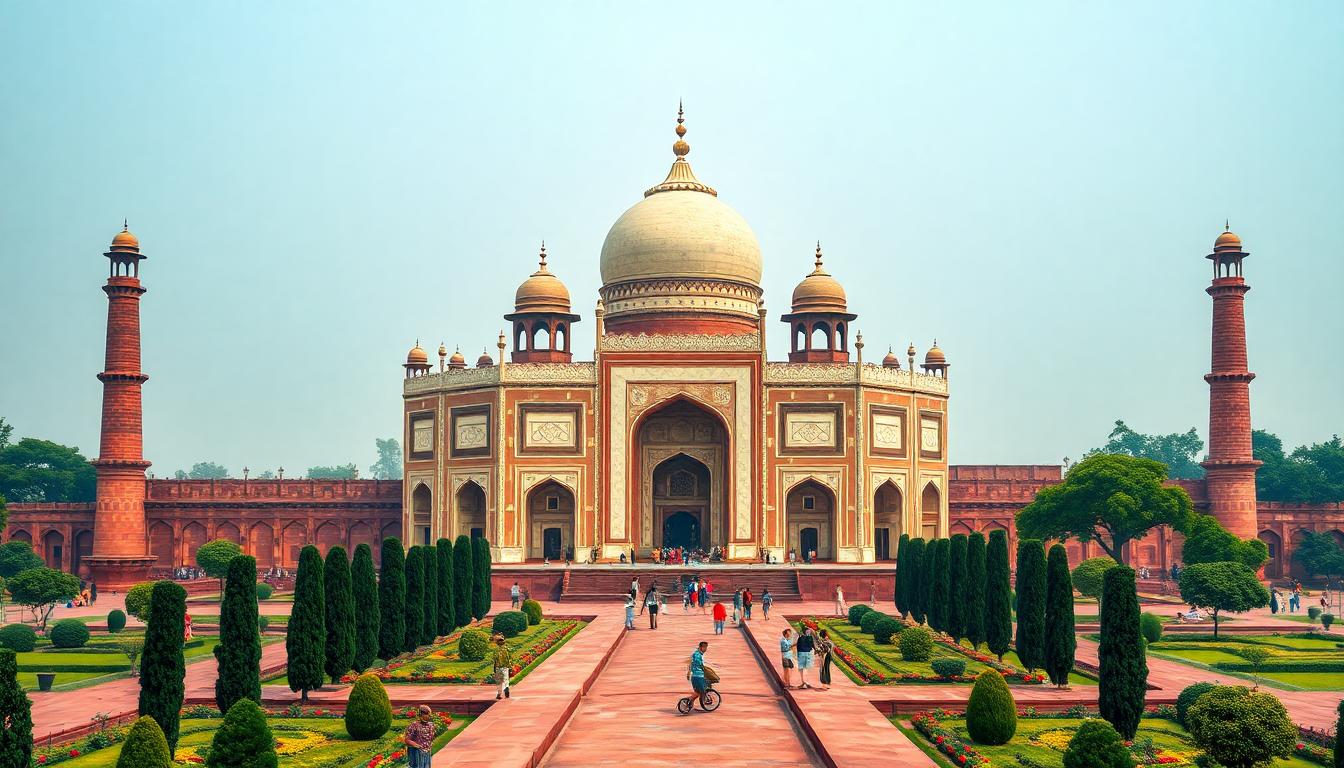
Covering most of the Indian subcontinent, the Mughal Empire was the largest of the three in terms of territory and population. Founded by Babur and reaching full strength under Emperor Akbar, the Mughal rulers built a system that combined Islamic rulership with careful tolerance of the subcontinent’s Hindu majority and other religious communities.
The empire’s administrative system was sophisticated, with the mansabdari ranking officials based on loyalty and merit, often cutting across ethnic and religious lines. Akbar promoted sulh-i kull or universal peace, which allowed for relatively peaceful coexistence and cultural flowering.
Mughal military power rested on the same gunpowder technology as its peers but also adapted local warfare methods. Trade thrived with access to major Indian Ocean ports, tying India into global commerce. The Mughals also left a lasting legacy in art and architecture, with masterpieces like the Taj Mahal blending Persian, Islamic, and Indian styles.
Common Threads and Global Influence
Although these empires competed, their shared origins from Central Asian Turkic-Mongol groups, use of Islamic law, and adoption of gunpowder technology link them as the "Gunpowder Empires." Each developed powerful standing armies and centralized bureaucracies while fostering vibrant cultural developments.
- Their control of trade routes boosted global commerce, especially via the Indian Ocean where goods, ideas, and travelers moved extensively.
- Their state religions and patronage helped define and spread Islamic identity in diverse regions.
- Each empire’s capital became a center of learning, arts, and innovation that attracted scholars and merchants from across the world.
This trio shaped the early modern Islamic world and influenced regions far beyond their borders. Their legacies linger in art, culture, architecture, and social systems in a way that continues to inspire Muslim societies to this day.
For more on their development and impact, this overview of the Gunpowder Empires offers detailed insights into their military and political structures. To understand how trade linked these empires across oceans, exploring the Indian Ocean trade networks is a great place to start.
Modern Achievements and Contemporary Issues
Muslim history did not stop at the Golden Age or the rise of great empires. Today, Muslim-majority countries and individuals continue to make important strides in science, technology, culture, and global affairs. At the same time, contemporary issues such as Islamophobia and political struggles challenge these communities worldwide. Let’s explore some of the key achievements and hurdles shaping the Muslim world in recent times.
Advances in Science, Technology, and Education
In many Muslim-majority countries, science and technology are vital priorities. Governments and private sectors invest in:
- Space exploration: Countries like the United Arab Emirates launched their Hope probe to Mars and are expanding satellite programs for environmental monitoring and communications.
- Tech startups and innovation hubs: Cities such as Dubai, Istanbul, and Kuala Lumpur nurture tech entrepreneurs creating solutions in fintech, health tech, and artificial intelligence.
- Medical research: Universities and hospitals are advancing cancer research, genomics, and vaccine development, often collaborating internationally.
- Renewable energy: With abundant sunlight, countries like Saudi Arabia and Morocco lead ambitious solar power projects to diversify energy sources.
Education systems across the Muslim world are improving access to STEM fields while also modernizing higher education and research institutions. This push improves skills and widens opportunities for youth.
These trends show Muslim-majority countries are growing beyond traditional sectors into knowledge economies, shaping global science and technology progress.
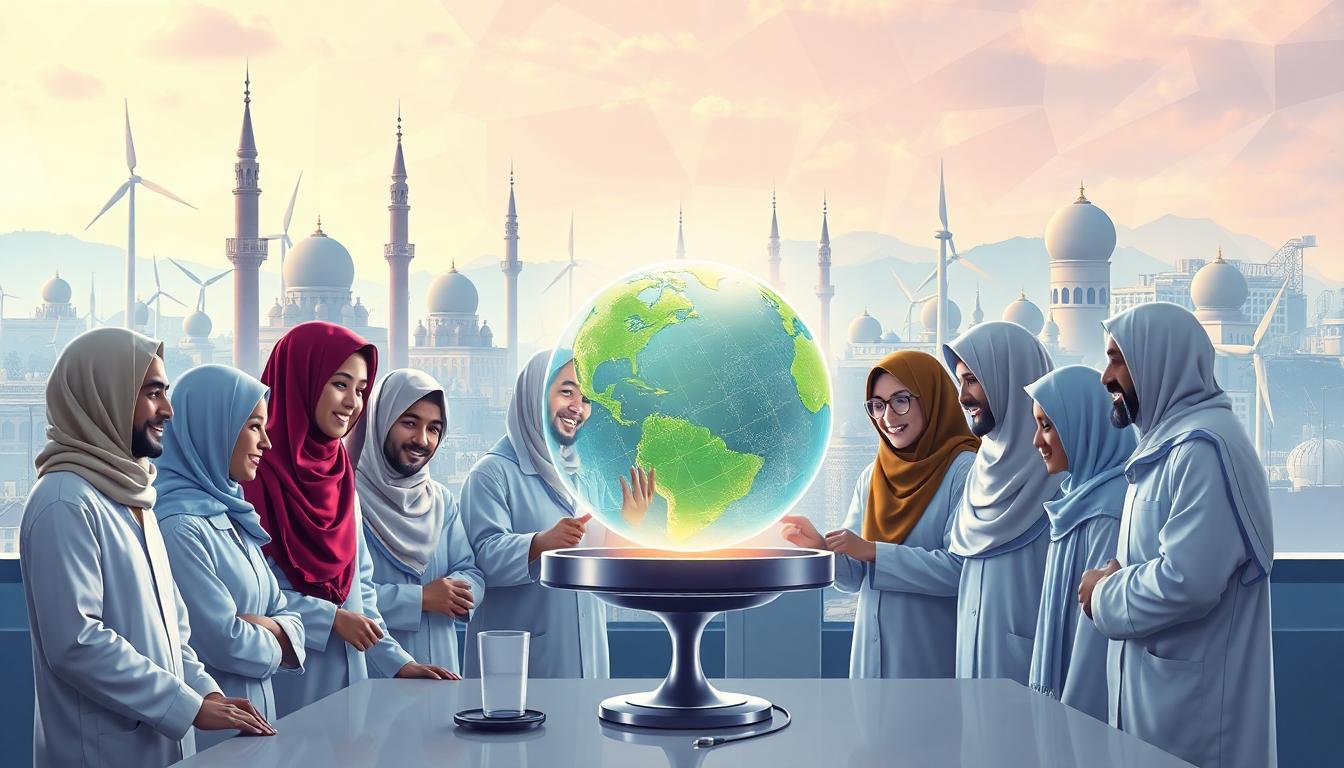
Young Muslim scientists collaborating in a modern lab set against a futuristic city background — Image created with AI
Economic Development and Cultural Influence
Many Muslim countries are transforming their economies beyond oil and natural resources. Efforts focus on:
- Diversifying industries: Tourism, finance, entertainment, and digital services are growing rapidly. Places like Dubai and Istanbul are cultural and commercial crossroads.
- Global trade and investment: Muslim-majority markets attract foreign investment and engage in international supply chains. Countries also host major trade fairs and cultural festivals.
- Cultural exports: Music, film, literature, and fashion from the Muslim world reach wider audiences today. Platforms are raising visibility for diverse Muslim voices and talents.
These developments create jobs and strengthen international cultural ties. They also help shape a positive global image that counters stereotypes.
Diplomacy and International Cooperation
Organizations such as the Organization of Islamic Cooperation (OIC) work to promote solidarity among Muslim countries and address shared challenges. They focus on:
- Supporting peace efforts and conflict resolution.
- Encouraging education and economic cooperation.
- Combating Islamophobia through public outreach and diplomatic channels.
Diplomatic efforts increasingly involve cultural exchanges and interfaith dialogue, seeking understanding in a divided world.
Contemporary Challenges
Despite these gains, Muslims face serious challenges globally:
- Islamophobia: Rising hostility and misconceptions about Islam cause social exclusion, hate crimes, and restrictions in some countries. Negative media representation aggravates this problem, impacting millions of innocent people. The OIC and NGOs work actively to counter these narratives but the issue remains urgent. You can learn more about how Islamophobia affects communities and actions being taken here.
- Political instability: Several Muslim-majority countries struggle with internal conflicts, authoritarian regimes, or economic crises. These factors affect education, healthcare, and growth.
- Poverty and inequality: Despite natural wealth, disparities persist within and between Muslim nations, impacting development.
- Media portrayal: Media sometimes distorts Muslim perspectives or focuses disproportionately on conflicts, leading to misunderstandings and prejudice. The role of media can either amplify problems or promote awareness and respect.
Looking Ahead
Muslim communities are working to overcome these challenges while building on longstanding traditions of knowledge and culture. Youth engagement, education, and innovation provide hope for continued progress. Strengthening dialogue, both within societies and internationally, remains key to addressing misunderstandings and promoting peaceful coexistence.
The story of Muslims today is one of both hardship and achievement — a dynamic blend of heritage and a vision for a better future.
For those interested in the ongoing diplomatic efforts and challenges faced by Muslim countries, the role of the Organization of Islamic Cooperation (OIC) offers a useful perspective. There is also significant discussion on Islamophobia’s impact in the Modern Muslim World Notes which covers social, political, and cultural aspects.
This section highlights how the Muslim world today balances rich traditions with modern ambitions amid complex challenges. The achievements in science, technology, and culture show great potential, while the issues demand attention and action on many fronts.
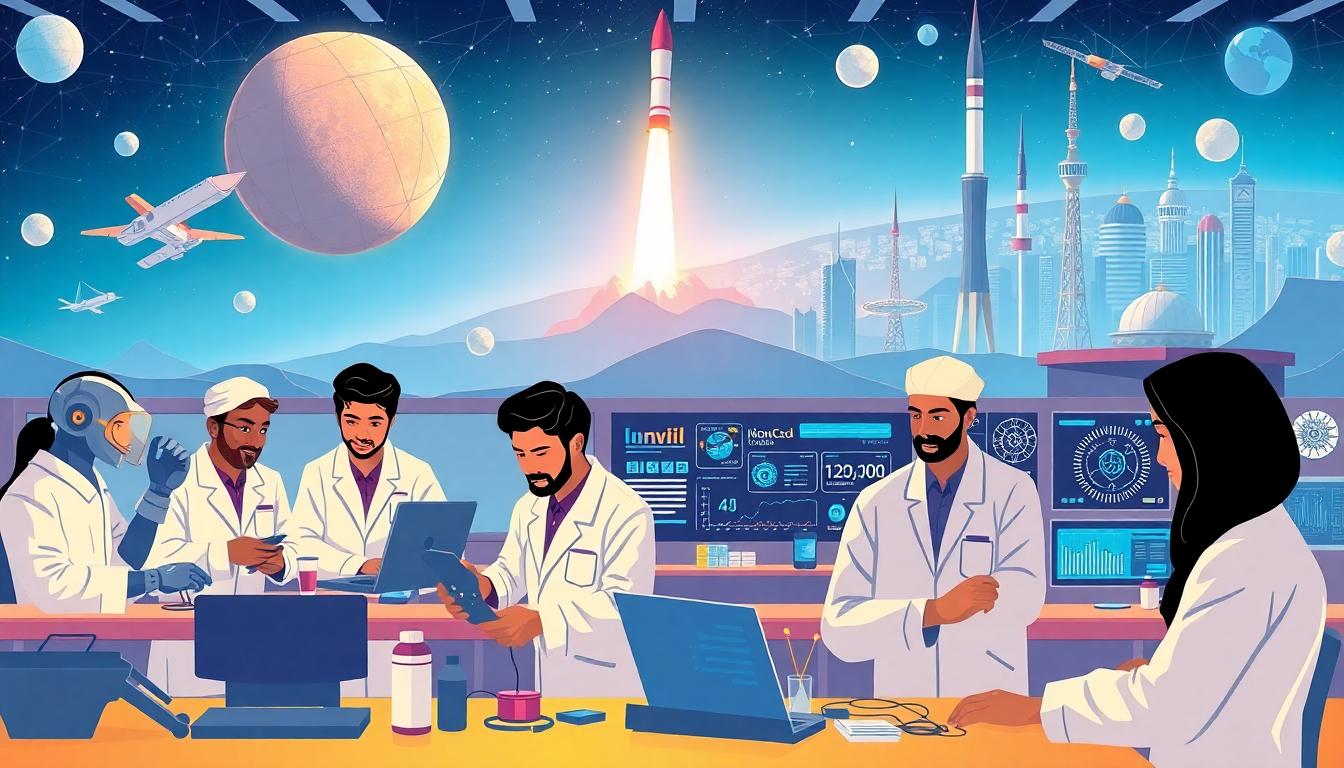
Scientists in Muslim-majority countries working on robotics and space technology merging tradition and innovation — Image created with AI
Conclusion
Muslim history, from its beginnings in the 7th century to the achievements of today, shows a story of growth, knowledge, and influence that spans continents and centuries. The early faith spread quickly, creating a vibrant culture that valued learning and justice. The Golden Age of Islam brought major advances in science, medicine, art, and governance, laying foundations that shaped the modern world. Later empires continued to build rich cultures and strong states, connecting regions through trade and shared beliefs.
Understanding this history helps us appreciate the diversity and contributions of Muslim cultures today. It reveals a tradition that blends faith with curiosity, resilience, and creativity. This legacy continues through modern achievements in technology, education, and global cooperation, showing that the spirit of innovation and cultural exchange remains alive.
Thank you for taking the time to explore this journey through Muslim history. Reflect on how these achievements shape our world now, and consider the many stories still unfolding.


0 Post a Comment:
Post a Comment