
Muslim History Facts You Never Learned in School (Surprising Stories and Contributions)
Muslim history stretches across continents and centuries, touching nearly every part of the world and shaping modern life in ways few people realize. From the earliest caliphates to thriving cities like Cordoba, Fez, and Baghdad, Muslim scholars, leaders, and everyday people have been at the center of discoveries that changed history. Yet, if you went to a mainstream school, chances are you only learned a fraction of what really happened.
Some of the most fascinating breakthroughs in science, medicine, and philosophy came from Islamic civilizations. Key inventions, pioneering hospitals, and the world’s first universities are just the beginning. This collection shines a light on remarkable stories and contributions that deserve far more recognition than they usually get in textbooks.
Whether you’re curious or want to set the record straight, these facts reveal how Muslim thinkers, builders, and communities have shaped our shared past. Prepare to be surprised—there’s so much more to Muslim history than meets the eye.
Watch: Historical Facts: Surprising Things You Didn't Learn in School (YouTube)
Pioneers of Science and Medicine
During the Islamic Golden Age, a wave of scholars made breakthroughs that still influence us today. They explored fields like algebra, medicine, astronomy, physics, and optics with a curiosity that pushed human understanding forward.
Algebra and Mathematics
Al-Khwarizmi, often called the father of algebra, wrote a book that introduced systematic solving methods. His ideas formed the basis for algebra that’s still taught in schools worldwide. Many of his techniques were based on earlier Greek and Indian works but refined by Muslim mathematicians. They also developed advanced arithmetic systems, making calculations easier and more precise.
Medical Innovations
Avicenna, known as Ibn Sina, authored The Canon of Medicine. This massive medical encyclopedia was a standard reference for centuries. It covered everything from anatomy and physiology to pharmacy and disease treatment. His work helped shape both Islamic and European medicine, influencing doctors for hundreds of years.
Astronomy and Optics
Muslim scholars like Ibn al-Haytham, also called the "father of optics," performed experiments that changed how we understand light and vision. His studies led to the invention of the camera obscura, the precursor to the modern camera. He also criticized Aristotle’s ideas and promoted empirical observation, which laid the groundwork for scientific methods used today.
Advances in Physics and Trigonometry
Nasir al-Din al-Tusi made strides in trigonometry, which became crucial for navigation and astronomy. He improved models of planetary motion and introduced mathematical tools that helped later astronomers understand celestial movements more accurately.
These scholars’ discoveries didn’t stay within the Islamic world. Their work traveled to Europe, fueling the Renaissance and beyond. Without their contributions, modern science and medicine might look very different today. If you want to explore more about their legacies, this article offers great insights into how their innovations continue to shape us.
Cultural Contributions and the Arts
Muslim history is not only about scientific and medical discoveries but also about powerful expressions in art, literature, architecture, and philosophy. The beauty that flourished in the Islamic world still inspires awe today, from the walls of Andalusian palaces to the words of poets whose verses echo across centuries. Let’s take a closer look at some of these lasting contributions.
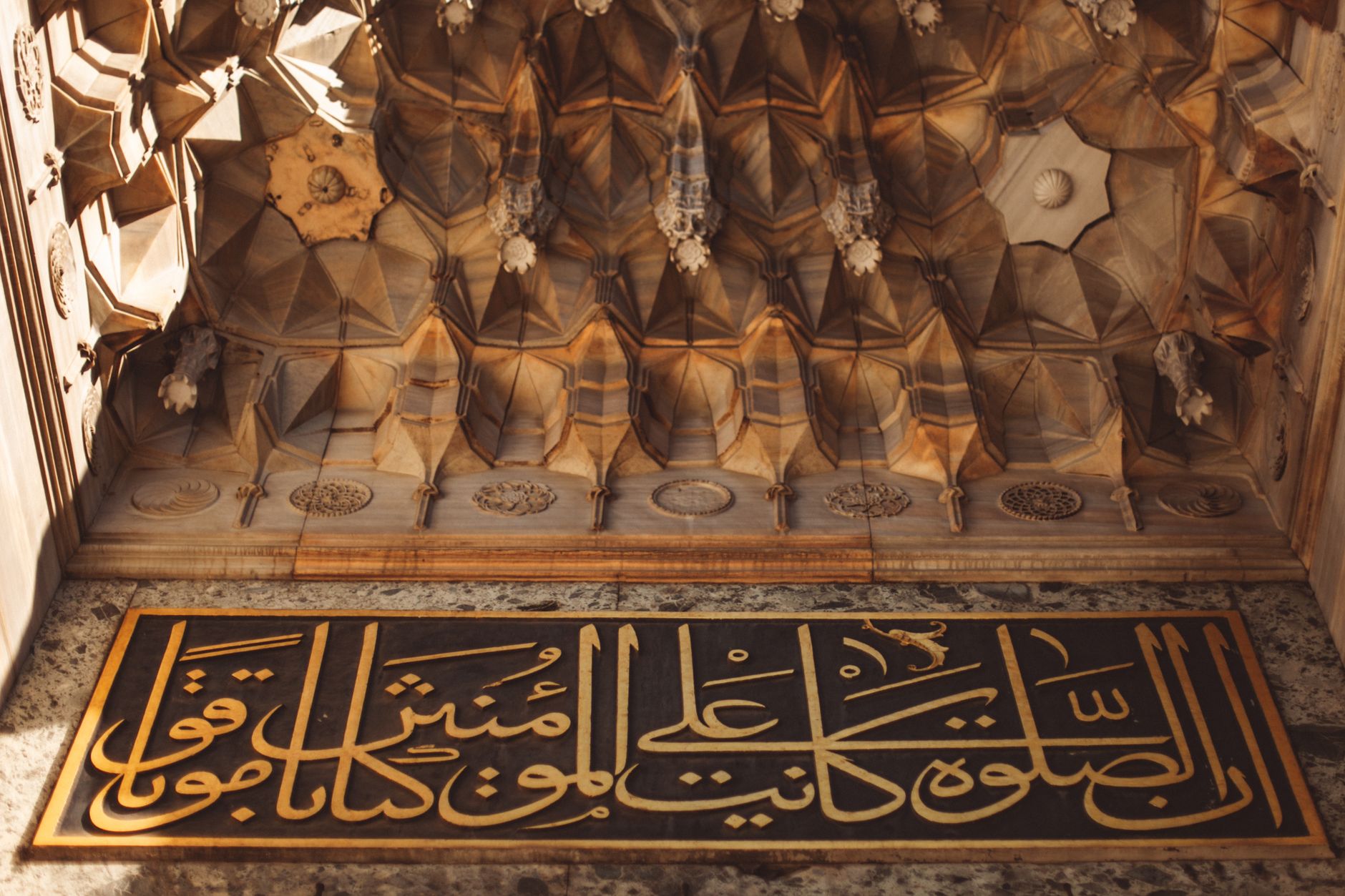
Photo by ROMAN ODINTSOV
Islamic Art and Geometric Patterns
Islamic art stands out for its detailed patterns and emphasis on non-figurative forms. Artists used geometry, symmetry, and repetition to create designs that remind you of endless possibilities and spark a sense of wonder. Patterns often include stars, polygons, and arabesques. These weren’t just for decoration—they represented unity, order, and the infinite nature of creation.
The Alhambra in Granada, Spain, is a perfect showcase for these designs. Its tilework and carved plaster fill the eyes with repeating motifs, vibrant colors, and bold symmetry. The patterns found in the Alhambra are some of the finest examples of Moorish creativity and are still studied worldwide. If you want a deep dive on how these designs were created and why they matter, check out the history of Islamic geometric patterns.
- Key features of Islamic patterns:
- Use of circles and stars
- Repeating motifs
- Balanced colors
- Avoidance of imagery with people or animals
See how the geometric patterns of the Alhambra continue to inspire modern artists.
Architectural Masterpieces
Muslim architects dreamed big. Their buildings brought together faith and function, using domes, arches, courtyards, and light in fresh ways. The Great Mosque of Córdoba, the Dome of the Rock in Jerusalem, and the dazzling Alhambra are a few highlights. Walking through these places, you can almost hear history whispering from every stone.
Architects used local materials and innovative engineering, often making use of water, gardens, and light. These designs weren’t only practical—they created places where beauty and spirituality mixed.
Take the Alhambra, for example. Built by the Nasrid dynasty, it stands as a crown jewel of Moorish art, filled with stunning halls and lush gardens. The harmony between architecture and nature in the Alhambra is legendary. For a closer look at this unique building, see the Islamic art of the Alhambra of Granada.
Poetry and Literature
Muslim poets and writers gave the world some of its most loved works. One name that stands out is Rumi. His poetry still rings true for millions today, speaking about love, peace, and unity. Rumi wrote in Persian but his message crosses languages and cultures. You can find his poems quoted in everything from spiritual books to coffee shop walls.
But Rumi was just one voice among many. Medieval Islamic literature included epic stories, histories, and even science told as tales, with vibrant characters and deep themes. Persian, Arabic, Turkish, and Urdu writers shaped the language of poetry for centuries. To learn more about Rumi and his influence, visit Rumi's biography and works.
Key literary highlights:
- Love poems that celebrate both faith and humanity
- Stories mixing adventure, learning, and humor
- Prose that wrestled with big questions like justice, freedom, and the meaning of life
Philosophy and the Translation Movement
The House of Wisdom in Baghdad was a hub for ideas from all over the world. During the Abbasid era, scholars there translated books from Greek, Persian, and Indian sources into Arabic. This sparked what’s sometimes called the first Renaissance. These translations didn’t just copy old ideas—they opened the door to new thinking in math, science, logic, and philosophy.
The translation movement connected cultures and allowed Muslim philosophers like Al-Farabi, Avicenna, and Averroes to ask big questions and share their answers around the world. This work reached Europe and shaped later philosophers during the Middle Ages and beyond. The House of Wisdom is now recognized as one of history’s most important centers for learning and sharing knowledge.
- Major achievements from the translation movement:
- Preserving and sharing ancient texts
- Developing new ideas by blending cultures
- Expanding philosophy and medicine with fresh thinking
The story of these cultural contributions shows how Muslim history is about more than old books or stones. It is a living legacy that still shapes art, poetry, architecture, and knowledge today.
Hidden Stories of Diversity and Tolerance
When you think of medieval Muslim societies, tolerance and diversity probably aren’t the first words that pop into your mind. Yet, hidden in the layers of history, there’s a rich story most textbooks leave out. Muslim communities created societies where Muslims, Jews, Christians, and others lived together—sometimes in surprising harmony—at times when religious wars swept through nearby lands. These stories may challenge what you assume about the past and show just how varied Muslim history really is.
Convivencia in Medieval Spain: An Experiment in Coexistence
In medieval Spain, under Muslim rule, a unique era known as convivencia saw Muslims, Jews, and Christians sharing cities, cultures, and even friendships. This period (roughly from the 8th to the 15th centuries) was far from perfect, but it stood out against the backdrop of religious strife elsewhere in Europe. In cities like Córdoba and Toledo, it was not unusual to find a Muslim philosopher, a Christian scribe, and a Jewish doctor, all working in the same royal court.
This collaboration led to some stunning achievements in philosophy, science, and the arts. Think of it as history’s version of an open-minded group project, where ideas flowed between faiths, sparking creativity and progress. Even poetry and music showed mixed traditions, with melodies and rhythms traveling from mosque to synagogue to church. To learn more about this remarkable chapter, check out the overview in Jews, Christians, and Muslims in Medieval Iberia (PDF).
- Shared learning: Scholars translated books from Arabic to Latin and Hebrew, keeping classical wisdom alive for future generations.
- Economic ties: Trade and business flourished with people from all backgrounds.
- Cultural overlap: Art, fashion, and architecture often mixed motifs from Jewish, Christian, and Muslim sources.
You can see more on how this cross-cultural exchange shaped Spanish society in this summary of medieval Spain’s interfaith life.
Early Islamic Policies: Protected Communities and the Pact of Umar
One of the first steps toward legalizing coexistence in Muslim-ruled lands came with documents like the Pact of Umar. Though its exact authorship is debated, this agreement outlined how, under Muslim rule, Christians and Jews (known as dhimmi) would be protected minorities. This protection meant freedom to practice their faith, run their communities, and keep their property, in exchange for a special tax and respect for certain rules.
- Key Agreements:
- Freedom to worship and manage local laws.
- Return for loyalty and a tax (jizya), instead of military service.
- Laws crafted to safeguard lives and property.
The principles in the Pact set a standard that spread across different empires. While not always applied equally, it was still strikingly inclusive for its era. You can read a plain-language summary on The Pact of Umar – The Ancient and Medieval World.
For a snapshot, here’s a simple table outlining basic rights and responsibilities:
| Community | Right to Worship | Autonomy in Civil Affairs | Protection by Law | Requirement |
|---|---|---|---|---|
| Muslims | Yes | Full | Yes | Military service |
| Jews | Yes | Yes (limited) | Yes | Pay jizya tax |
| Christians | Yes | Yes (limited) | Yes | Pay jizya tax |
Learn more about the background and impact of the Pact in this Wikipedia article.
The Ottoman Millet System: Managing Diversity
Much later, the Ottoman Empire built its own version of coexistence with the millet system. Under this approach, each religious group managed its own schools, courts, and community organizations. As long as they stayed loyal, these communities often flourished and contributed to the economic and cultural fabric of the empire.
This organization by faith group kept the peace in a realm that covered parts of three continents! While equality wasn't perfect, it created room for cultural diversity, relative stability, and wide-ranging contributions from Armenians, Greeks, Jews, and Muslims.
- Self-governance encouraged trust and participation from minorities.
- Local leaders represented their communities in empire-wide affairs.
- Religious festivals and sacred spaces were respected by law.
Historians still debate how tolerant things always were, but these policies stood out against a backdrop of forced conversions and persecution elsewhere. You’ll find interesting details and discussions on the social fabric of these communities in this research paper covering multicultural societies in Andalusian Spain.
These are just glimpses of how Muslim societies tried, sometimes with real success, to build communities that were both diverse and (at least by the standards of their time) unusually tolerant. While no society is perfect, these hidden stories reveal approaches to diversity and coexistence that are rarely given enough credit in standard histories.
Muslims Shaping Modern History
Muslims have never been just a part of history—they’ve often led the way, building new connections across continents, industries, and communities. From West African kings with legendary wealth to American Muslims rallying for civil rights, these stories paint a much bigger picture than textbooks usually offer. Here are a few moments and individuals who shaped recent history in ways worth sharing.
Mansa Musa: The Emperor Who Changed the Map
Mansa Musa, ruler of the Mali Empire in the 1300s, was more than wealthy—many call him the richest man in history. He ruled over an empire that controlled nearly half the world’s gold at the time. What set Musa apart wasn’t only riches, but how he used them.
On his famous journey to Mecca in 1324, he brought along a caravan so large it stunned every city that saw it. His journey was so extravagant that Cairo’s gold market crashed from the amount of gold he gave away. But what left an even bigger mark was how Musa invested in education and culture. He turned Timbuktu into a thriving center for learning, with schools and mosques that drew scholars from all around. Learn more about Mansa Musa’s massive impact.
- Timbuktu’s growth: Musa’s vision added libraries and universities to West Africa, putting it on the world map for knowledge, not just gold.
- Trade and diplomacy: His connections tied West Africa to Europe, North Africa, and the Middle East, helping fuel centuries of exchange.
Explorers and Inventors: Boundaries Broken
Muslim explorers didn’t just travel—they redefined the meaning of “global.” Take Ibn Battuta, who set off from Morocco in 1325 and covered over 75,000 miles (triple Marco Polo’s journey). He visited more than 40 modern countries, keeping a detailed log called the Riḥlah, which offers a firsthand view of Africa, the Middle East, India, and even China. Ibn Battuta’s Riḥlah is one of the world's greatest travel chronicles.
Inventors like Ismail Al-Jazari in the 12th century designed mechanical devices—including early automata and water-powered clocks—that proved the Muslim world’s hunger for practical invention. Their successes remind us that the boundaries reached far beyond the Middle East.
Muslim Americans in the World Wars
Muslim contributions to recent history get even less attention when the story moves to the West. During World War II, at least 1,500 Muslim Americans served, a group that included Arab, African American, and South Asian Muslim soldiers. They wore the uniform, fought on battlefields, and contributed to the home front alongside other Americans. Their service was part of a much larger picture linking American Muslims to the nation’s growth and its struggles for liberty. See the timeline of American Muslim involvement in WWII.
- Diversity in the ranks: Muslim soldiers stood shoulder-to-shoulder with other Americans, fighting the same battles and facing the same risks.
- Hidden stories: Their names are often left out of history books, yet their medals and records remain.
Leadership and Civil Rights in the United States
The story of Muslims shaping modern history includes powerful voices in the fight for equality. African American Muslims, for example, played a key role in the American civil rights movement. Malcolm X’s journey—from street hustler to Muslim leader and human rights activist—changed minds, inspired millions, and connected U.S. struggles for equality with global calls for justice.
Organizations like the Nation of Islam pushed for self-respect, education, and Black economic empowerment. Their message influenced not only Muslim Americans, but other communities fighting for dignity and belonging. Immigrant Muslim communities also joined the struggle, building mosques and alliances across the country.
- Malcolm X: He spoke out at the United Nations and made the Hajj, highlighting the universal bonds of faith and human rights.
- Building bridges: Muslim leaders joined coalitions on voting rights, workplace rights, and interfaith work.
For a deeper read on long-overlooked stories of Muslims in American history, check out this downloadable book on the legacy of Muslims in America.
Muslims have always been more than bystanders—they’ve made history in ways you probably didn’t hear about in school, from golden cities to milestones in American freedom. These stories only scratch the surface.
Conclusion
Learning these overlooked facts about Muslim history helps paint a fuller, more honest picture of our world. Stories of scientific insight, cultural creativity, and everyday acts of tolerance are too important to leave out. Taking time to discover Muslim contributions—often missed in mainstream classes—sharpens how we see the past and each other.
Curiosity is the first step. Keep exploring, ask questions, and share what you find. If you enjoyed these insights, dig even deeper into the rich stories and legacies still waiting for recognition. Thanks for reading, and feel free to share your own discoveries or thoughts below.


0 Post a Comment:
Post a Comment